What does ferritin mean? — A plain-English guide to your iron storage marker
Ferritin is your body's iron savings account. When it's low, you can feel tired before standard anemia shows up on a blood test. When it's high, the reading often points to inflammation rather than "too much iron." The number on its own rarely tells the full story — your trend over time and the rest of your panel matter more. This is one of those markers your doctor probably mentions in passing and doesn't have the appointment minutes to fully explain. Here's the longer version.
5 min read
What does ferritin mean? — A plain-English guide to your iron storage marker
Ferritin is your body's iron savings account. When it's low, you can feel tired before standard anemia shows up on a blood test. When it's high, the reading often points to inflammation rather than "too much iron." The number on its own rarely tells the full story — your trend over time and the rest of your panel matter more.
This is one of those markers your doctor probably mentions in passing and doesn't have the appointment minutes to fully explain. Here's the longer version.
What ferritin actually is
Ferritin is a protein that stores iron inside your cells, mostly in the liver, spleen, and bone marrow. A small amount circulates in the bloodstream, and that's what a lab test measures. The circulating amount tracks the larger storage pool reasonably well — so when serum ferritin is low, your overall reserves are usually low; when it's high, your reserves (or your inflammation level) are usually high too.
Iron itself shows up on lab reports in a few different ways: serum iron (what's in your blood at the moment of the draw), transferrin or TIBC (the protein that carries iron around), and ferritin (the storage form). They answer different questions. If you only see one of them, ferritin is often the most useful single signal for long-term iron status.
What's a typical reference range?
Reference ranges vary by lab, by sex, by age, and sometimes by the assay method used. As a rough orientation:
- Adult men: typically around 30–400 ng/mL
- Adult women (pre-menopause): typically around 15–150 ng/mL
- Adult women (post-menopause): tends to shift toward the male range
Your lab report will print its own reference range alongside your result — always read the number against the range from the same report, not against numbers you found elsewhere. Two different labs can return "the same" reading with different range labels.
What low ferritin tends to mean
Low ferritin means your iron storage is depleted. The body protects circulating iron longer than it protects stored iron, which is why ferritin drops first — and why a lot of people feel run-down before a complete blood count (CBC) flags anything.
Common things associated with low ferritin:
- Iron loss faster than iron intake (heavy menstrual bleeding, frequent blood donation, gastrointestinal bleeding)
- Reduced intake or absorption (restrictive diets, celiac disease, low stomach acid, certain medications)
- Pregnancy and the postpartum period
- Endurance training without enough dietary iron
What it tends to feel like: fatigue that doesn't respond to sleep, breathlessness on light activity, cold hands and feet, restless legs at night, hair shedding, brain fog. None of these are specific to low ferritin — each can have many other causes — but they're worth mentioning at your next appointment if your ferritin is on the low side.
What high ferritin tends to mean
High ferritin is more often a signal of inflammation than a signal of too much iron. Ferritin is what's called an acute-phase reactant — it rises during infection, chronic inflammatory conditions, recent surgery, liver disease, and metabolic conditions like fatty liver or insulin resistance.
Less commonly, high ferritin reflects a true iron overload, like hereditary hemochromatosis. This is why doctors usually look at the ratio between transferrin saturation and ferritin together: if saturation is also high, iron overload becomes more plausible; if it's normal or low, inflammation is the more likely story.
A single high ferritin reading is not the same as a diagnosis. It's a flag to look at the rest of the panel and at your medical history with your doctor.
What ferritin does not mean
Ferritin is not a willpower meter. It's not a measure of how "healthy" your diet is. It's not a stand-alone screen for iron-deficiency anemia (a CBC plus iron studies does that job better). And it's not a number you can chase up or down by aiming at a specific value — what matters is your trend over time and how the reading fits with the rest of your bloodwork.
How to track it with Bllod
Bllod reads your lab PDF, pulls every marker including ferritin, and shows your reading on a timeline with your previous results — so the trajectory is visible, not just the single value. If your ferritin has been drifting down over three or four panels, you'll see that before you feel it. [App Store link]
The goal is not to optimize the number. It's to read it in context, alongside the markers it tends to move with.
A few common questions
Can you have low ferritin without anemia?
Yes. Ferritin drops before hemoglobin does. Many people have low ferritin and feel the effects (fatigue, breathlessness on exertion) for months before standard anemia would show up. The technical name is "iron deficiency without anemia."
Is ferritin the same as iron on a blood test?
No. Serum iron is what's circulating right now; ferritin is what's stored. Both are useful. For long-term iron status, ferritin is usually the better single signal.
What's the difference between ferritin and hemoglobin?
Hemoglobin is the oxygen-carrying protein in your red blood cells. Ferritin is your iron reserve. Hemoglobin tends to stay normal until your reserves are very depleted, which is part of why ferritin is the earlier warning.
When should I mention a ferritin reading to my doctor?
Any time your reading sits outside your lab's printed reference range, or any time you see a clear trend (down or up) across three or more recent panels. Your doctor can read it against the rest of your medical history, which is the part a blog post can't do.
This article is informational. It is not medical advice and is not a substitute for a conversation with a qualified clinician.
Related articles

Blood Test MarkersNutritional Deficiency
What does low vitamin D mean? — A plain-English guide
Low vitamin D usually means your body's stores of the sunshine vitamin have dipped — common in winter and indoors. Here's what the marker measures and what a low reading does and doesn't mean.
4 min read
Thyroid HealthHypothyroidism
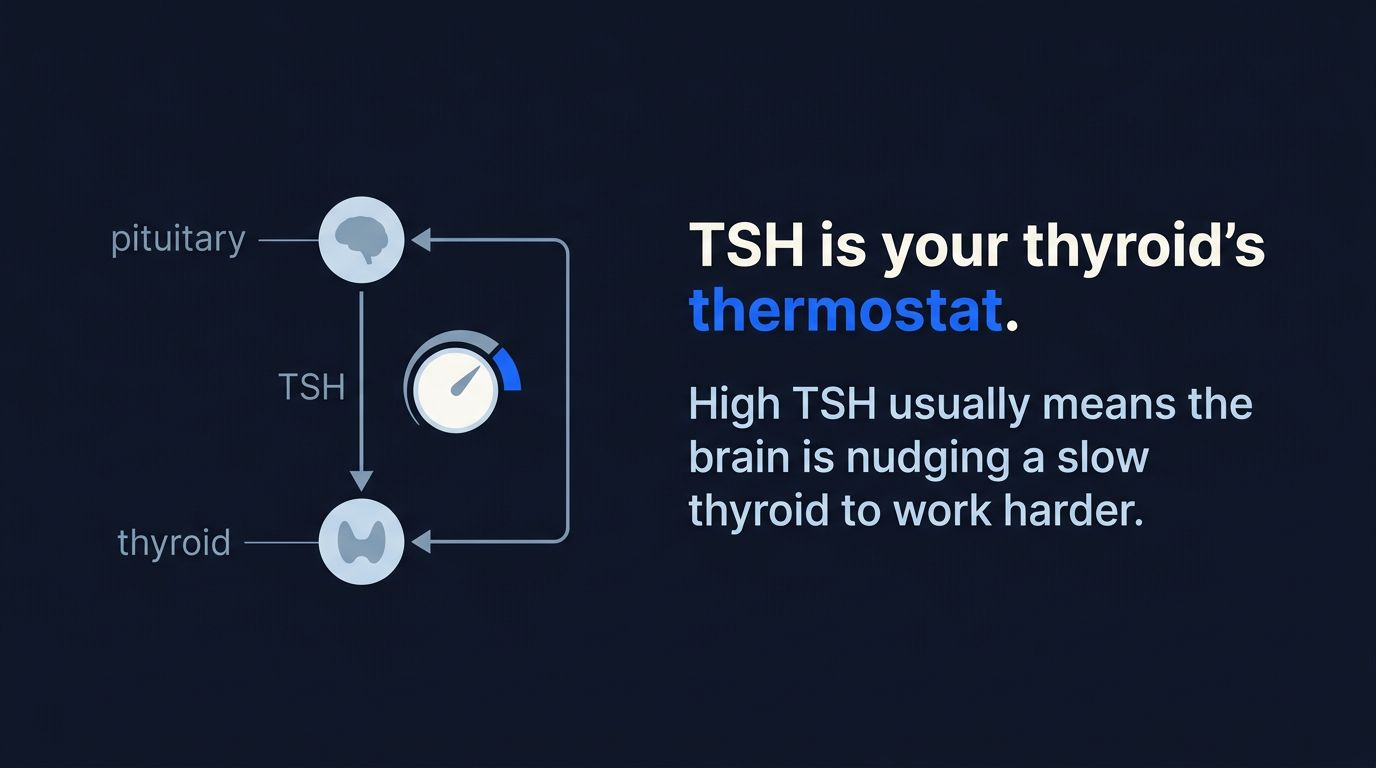
What does high TSH mean? — A plain-English guide
High TSH usually means your brain is nudging your thyroid to work harder. Here's what the marker measures, why it matters, and what to do next.
4 min read
Cardiovascular HealthBlood Test Markers
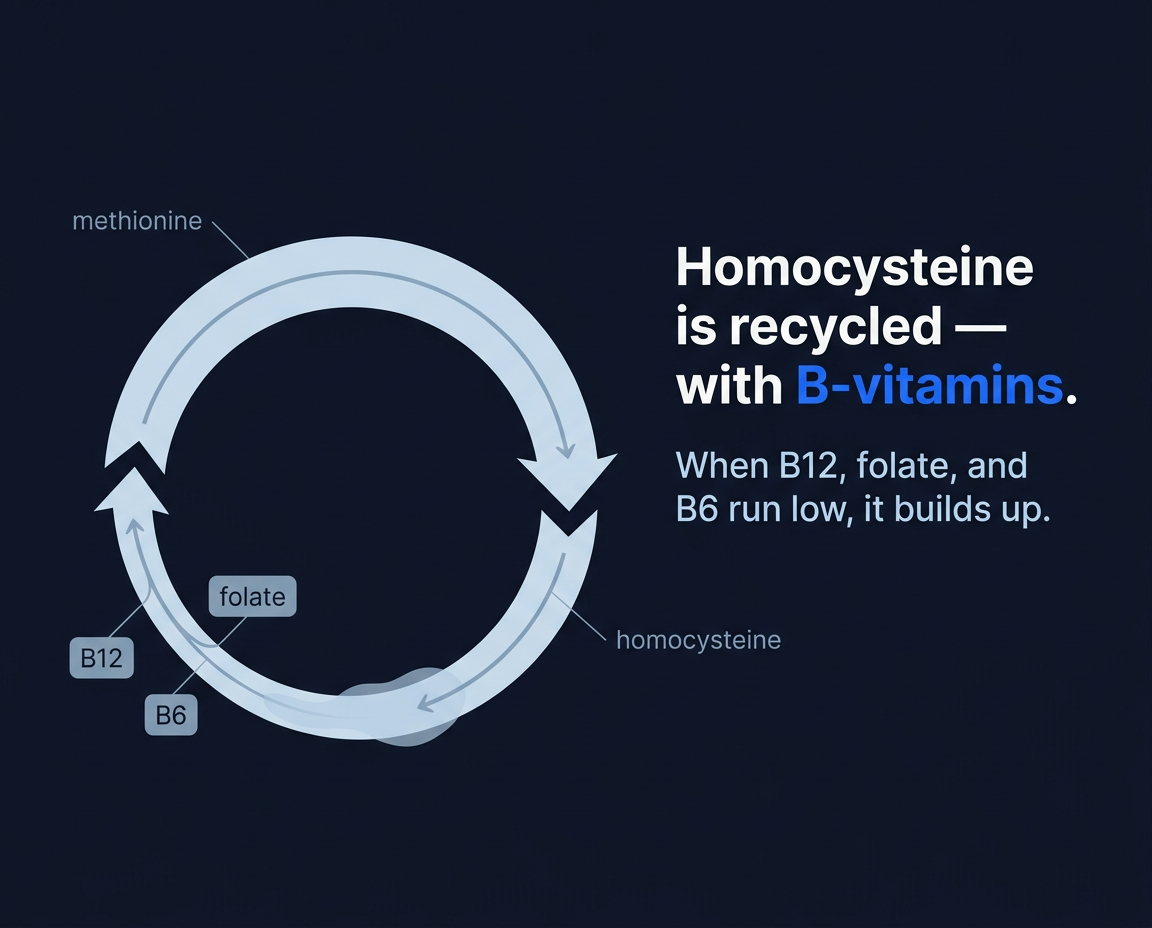
What does high homocysteine mean?
A high homocysteine means more of this amino acid is building up in your blood than your body usually keeps around. Most of the time that happens because the B-vitamins that normally recycle it — B12, folate, and B6 — are running low. On its own it doesn't diagnose anything. It's one signal that, read in context, can flag a B-vitamin gap or add a little color to your cardiovascular picture. That's exactly why it's worth understanding rather than fearing.
4 min read